Showing posts with label Mother Sauces. Show all posts

Thursday, March 25, 2010

Mac n' Cheese Marathon


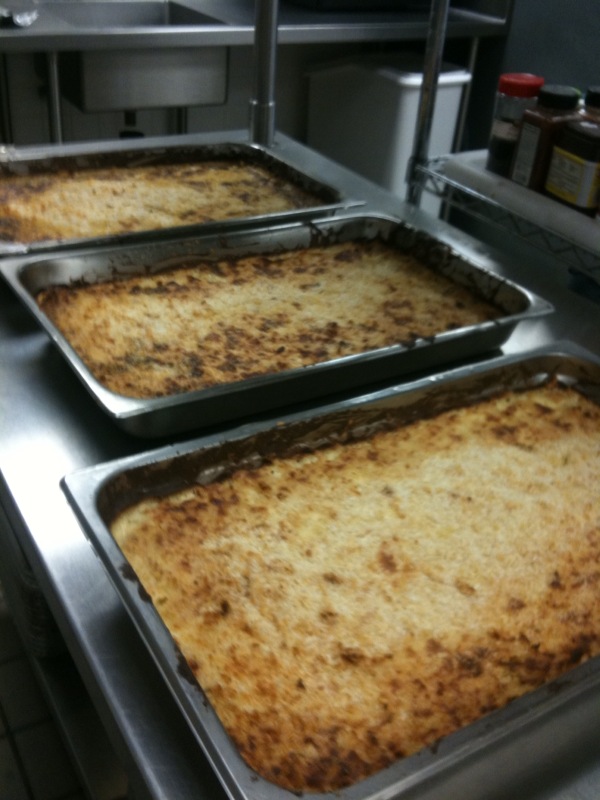
The class was psyched for today's lesson -- everyone loves mac n' cheese, and we were going to make three versions. The point was to get them thinking about sauces. It's one thing to lecture about mother sauces (which I did, which did not elicit much interest), it's another thing to make a sauce and apply it in real life.

Mac n' cheese is not just macaroni slathered in cheese -- if we did that, and baked it, you'd get a dry, burnt, excessively lumpy mass that would congeal and room temperature to something guaranteed to back you up (at the least.) That thing that makes a mac n' cheese something more is the sauce: Bechamel, a mother sauce which is white sauce made by thickening milk with a white roux. A roux is the classic thickening agent that is made by cooking equal parts fat and flour (in this case, butter and AP.) Once we have our bechamel, we add out cheeses and seasonings (see the recipe here), then into a pan with very stiffly cooked macaroni to bake and come together.

Traditionally, the seasoning is salt, pepper and mustard powdered, and that's what we did with one version. Another version we added crumbled bacon and extra mustard powder, and a third replaced the mustard with jerk seasoning and a bunch of softened diced onion.

This is not light food, so I thought rather than make another heavy sauce dish, make a protein and a veg to make a balanced plate of food. I got one student to just go for it, sauteing a bag of adult spinach leaves. Super simple: heat saute pan, add a little olive oil, drop in dry leaves, move around until wilted, then add more until it's all in pan. Salt while cooking to taste. Stop and remove from heat when all is wilted.

The protein was "shake n' bake" chicken. Simply, take chicken breasts cut to size and dredge in a flour and spice mix, then bake.

HOME MADE “SHAKE N’ BAKE” CHICKEN BREASTS

Yield: 8 servings
Flour 1 cup
Corn meal ½ cup
Old bay seasoning 2 tsp
Paprika 2 tsp
Black pepper 1 tsp
Salt 2 tsp
Chicken breasts 8 each
1. Grease baking sheet. Preheat oven to 350
2. Combine all ingredients except breasts in a bowl
3. Toss breasts in mixture then place on greased sheet.
4. Bake for 25-30 minutes or when meat thermometer reads 155˚.
5. Rest meat for 10-15 minutes covered in foil, then serve.

Old Bay Seasoning is basically celery salt and paprika, and the final result was surprising like the commercial shake n' bake mix, only without the extra chemicals or anti-caking agents.

The kids were not impressed with the chicken -- they liked the seasoning, but it was too "dry" for them (though due to the instant read thermometer, the bigger pieces did come out juicy, the smaller pieces were a bit tough.)

However, there was universal acclaim for the spinach. None seemed to ever have a simple spinach like this, done fresh -- usually, if at all, they've had it from frozen. I think a few kids said they're going to make that at home, which really made me feel like today's class wasn't JUST a fat n' carb festival.

We also made a vat of chicken stock, which will factor in to the next lesson: grains, including rice, farro and buckwheat...

Wednesday, October 28, 2009

Cooking in Quantity


I really don't know what this poster in the school cafeteria was about. My supervisor didn't know, either. Something tells me I really don't want to know. Yum-o, I say. Yum. O.

The syllabus was all about stock and sauces, but we also needed to cook for PTA parent-teacher conferences tomorrow. Rather than be capped at 3 hours, we took 4 and a half to get it all done.

We started with a short lecture about mother sauces and the danger zone. The danger zone is 60 through 140 degrees -- the zone where bacteria will grow and multiply if given the three elements it needs: protein for food, moisture for environment, and low acidity. Stock has all three.

Bechamel, veloute, espagnol, tomato, hollandaise -- today we were making bechamel -- warm milk thickened with a roux. Roux is equal parts fat and flour, whisked while cooked to turn it into a paste. The darker it goes, the bigger flavor it'll have. This would be the base of our Mac n' Cheese....

MACARONI & CHEESE

Yield: 30 servings
Elbow macaroni 5 lbs
Butter 1 ½ cups
Flour 1 ½ cups
Whole milk 1 ¼ gallon
Salt & pepper to taste
Worcestershire sauce to taste
Cheddar, cubed 1 ½ lb
Mozzarella, cubed 1 ½ lb
Monterrey jack, cubed 1 ½ lb
1. Preheat oven to 350˚. Warm milk, but do not boil. Grease 4 large hotel pans. Bring enough salted water to a boil. Add pasta, cook until very al dente – 2 minutes shorter than package suggestion.
2. Melt butter and stir in flour to make a roux. Whisk in warm milk a ladle at a time to make white sauce. BTB RTS. Salt and pepper to taste.
3. Remove sauce from heat, stir in three cheeses. Combine with pasta and stir well. Pour into baking dishes.
4. Bake 45-60 minutes, or until top is desired crispiness. Rest 20 minutes before serving.

I had the kids taste the cheese sauce before and after adding salt and Worcestershire, really bringing home the importance of NEVER forgetting seasoning.

This was my own recipe -- the syllabus had a horrible recipe involving mustard powder. The teacher who lead this program the last two cycles stopped by and ate with us, and confided that the first time she taught this program, she stuck closely to the syllabus and all the kids pretty much were grossed out by the mac n' cheese. This recipe is pretty solid, except this was the first time I was using the ovens in this kitchen -- they ran hot, and they ran uneven. The final product was a little over-done, but still very edible, very rich and decadent, if not as loose as I would of liked.

Before class, I got chicken stock on the fire. We just had too much to do and this is a 4 hour affair, and I got whole chickens that had to be broken down without fuss or drama.

CHICKEN STOCK

Yield: 1 gallon

Chicken bones 8 lbs
Cold water 1 gallon
Salt 2 tsp
Mire poix, medium dice 1 lb
Sachet d’Epices 1 each

1. Rinse bones, place in stockpot, add water and salt.
2. BTB RTS
3. Simmer 2-3 hours
4. Add mire poix and sachet, continue to simmer 1 more hour, skimming scum as necessary
5. Strain. Use immediately (degrease by skimming if necessary) or rapidly cool and store for later use.

The mac n' cheese was done in one huge batch broken into three hotel pans. Once into the oven, I demoed the brownie recipe. One kid asked why we didn't use a double-boiler to melt the chocolate -- an excellent question. Because we were melting it with butter, it was protected by the water content in that fat. As long as we didn't boil it, we were safe over an open flame.

FUDGE BROWNIES

Yield: 12 servings
Butter 1 cup
Unsweetened chocolate 4 oz
White cane sugar 2 cup
Eggs 4 each
Vanilla extract* 1 tsp
Salt ½ tsp
1. Preheat oven to 350˚. Grease a 9x13 baking pan
2. In a 3-quart saucepan, met butter and chocolate over low heat, stirring constantly until fully melted and incorporated.
3. Remove for heat, stir in sugar. Allow to cool slightly.
4. Beat in the eggs one at a time, mixing well after each.
5. Add vanilla and salt, stir well.
6. Fold in flour, mix minimally. Spread batter into pan.
7. Bake 30-35 minutes. Brownies are done when toothpick is inserted into center and comes out clean. Cool in pan on wire rack.

*Can be replaced by scrapings of 1/2 vanilla bean

Since there is only four burners that are accessible at once, we broke into four teams and they made the brownies, with me looking over and giving guidance as we went. Soon enough, five trays of brownies joined the mac n' cheese in the oven.

Two students took on the Caesar Salad, and four students got to work on the green salad. The Caesar was pretty straight forward. First step was making the croutons...

CROUTONS

Yield: 1 lb
White bread 1 lb
Butter, melted 4 oz, or as needed
Salt 1 tsp, or as needed
Black pepper, ground ½ tsp (optional), or as needed
1. Remove the crust from the bread if desired. Slice and cube the bread into desired size. If bread is fresh, dry out cubes in over for 5 minutes before continuing.
2. Toss the bread, fat and season together on a sheet or hotel pan.
3. Bake at 450˚ until lightly golden, 8 to 10 minutes

The great thing about this was that it was super simple, and the end result was INSANELY better than the crap you buy in a box, industrial croutons that are designed to be shelf-stable forever and taste like weird chemicals. The student who I was directing to flip and stir the croutons said she really did not like croutons. I picked one up and put it in her mouth by hand, and I could see the lights turn on in her eyes. THIS is why we cook from scratch and not buy a box. Sure, it's cheaper, but the real reason is that it is so much better. Rather than an industrial interpretation of what a crouton is, here she had the REAL thing for the first time, just as they were made when they were invented. True dat. Hollah.

CAESAR SALAD WITH CHICKEN

Yield: 10 appetizer servings
Romaine lettuce, chopped 1 lb
Croutons 12 oz
Sliced chicken breast 25 oz

Garlic. minced 1 tsp
Anchovy fillets 5
Salt ¾ tsp, or as needed
Black pepper, ground ½ tsp
Egg yolks 2
Lemon juice 2oz
Olive oil 10 floz
Parmesan, finely grated 6 oz, or as needed
1. Separate romaine leaved. Clean and dry thoroughly. Tear or cut into pieces. Refrigerate until ready to serve.
2. Prepare croutons and hold at room temperature until ready to serve
3. To prepare dressing, mash together garlic, anchovies, salt and pepper in a bowl to form a relatively smooth paste. Add egg and lemon juice and blend well. Gradually add olive oil, whisking as it is added to form a thick emulsion. Stir in Parmesan. Adjust with salt and pepper as necessary.
4. Pan-sear chicken right before service. Slice when rested.
5. For each serving, combine 2 oz greens with 1 floz dressing, tossing gently until evenly coated. Garnish with a few croutons. Top with 2.5 oz sliced chicken.

The dressing's key is to mash the anchovies and garlic until it is homogeneous (a word I had to define for my student, which was cute!) before making the emulsion. Because of a student allergic to seafood, we had to serve the salad with the dressing on the side.

The other four got to work on the tossed salad for the meeting tomorrow. A lot of knife skills involved here, and I demoed how I wanted each element. I had them peel the celery, just like my wife likes....

SIMPLE GREEN TOSSED SALAD

Yield: 20 servings
Boston lettuce, chopped 3 head
Romaine lettuce, chopped 3 head
Carrots, peeled, rounds 2 lb
Cucumbers, peeled, sliced, quartered 4 each
Red onion, diced 2 each
Red peppers, diced 2 each
Celery, peeled, sliced 1 head
Simple red wine vinaigrette 2 cup
1. Toss all vegetables together in a large bowl.
2. When ready to serve, pour vinaigrette over, toss, serve immediately

We made the vinaigrette almost as an afterthought, and the student muffed it, with too little seasoning....

SIMPLE RED WINE VINAIGRETTE

Yield: 2 cups
Red wine vinegar 4 oz
Dijon mustard 1 tsp
Olive oil 2 lb
Salt to taste
Pepper to taste
Sugar to taste
1. Combine vinegar and mustard in an anchored bowl.
2. Whisk in oil gradually.
3. Season with salt, pepper and sugar.

We didn't have time to muck around with it, but will remake it tomorrow when we prep for the event.

The class ended with the four burners given over to saute pans. I demoed how to butterfly a chicken breast by cutting it length wise but leaving the two halves attached, so it could be opened like a book. Uncut, the cutlets would be too thick to cook all the way through and would have to be finished in the oven, which we just did not have time for.

SAUTEED CHICKEN BREAST

Yield: 1 serving
Chicken breast, boneless, skinless 1 each
Salt to taste
Pepper to taste
Vegetable oil ½ floz
1. Season chicken cutlet with salt and pepper
2. Heat sauté pan over medium-high heat, then add oil
3. Saute cutlet for 2-3 minutes per side or until done.
4. Rest ½ the time of cooking before serving or slicing.

The magic moment is when you turn the meat over and everyone sees the browning. A typical home cook will keep on moving the meat and no browning happens. It's a sexy "ooo" moment. Every one cooked at least one breast, and another student sliced the meat, to which I had to hold her up as to not cut unrested meat.

I dashed out a bit of whipped cream to go with the brownies as the kids cleaned up.

WHIPPED CREAM

Yield: 16 servings
Heavy cream 1 cup
Vanilla extract* 1 tsp
Confectioners sugar 1 tbsp
1. In a large bowl or mixer with whip attachment, whip cream until stiff peaks are just about to form.
2. Beat in vanilla and sugar until peaks form. Make sure not to over beat, cream will then become lumpy and butter-like.

*Can be replaced by scrapings of 1/2 vanilla bean

We sat, ate with the supervisor and last year's teacher, and everyone seemed pretty happy with the food. I didn't like the over-doneness of the baked goods, but in the end, every one dug it so I didn't want to disrespect the student's efforts. Just because I'm hard on my own cooking doesn't mean I should be a spoilsport. Tomorrow we reconvene to make sandwiches, dress the salad, reheat the baked goods, plate the food and try to impress the parents...

Wednesday, May 14, 2008

The Grand Sauces (It's a Mother SHUT YO MOUTH!)

The four (or maybe five) grand sauces were invented by the French for the purpose of streamlining kitchen work. They can be made in huge batches, held aside in the cooler, and used to make an incredible amount of derivative sauces. Hence the nickname, 'mother sauces,' and their five inherent characteristics:
  1. A mother sauce is thickened with roux (flour and fat cooked together)
  2. A mother sauce is made in advance
  3. A mother sauce is made in large batches
  4. A mother sauce is nappe (coats the back of a metal spoon, yet still pourable)
  5. A mother sauce is used to make derivative sauces (in smaller batches)
Four mother sauces follow these strictly. The fifth, Hollandaise, follows none except the last. According to Chef M, it is debatable whether it is a mother sauce, but we would not be making it today.

Introducing the four big mama jamas!!
  • Espagnole (Brown Sauce): Brown veal stock, brown roux, mirepoix (browned carrots, onion, celery), tomato paste, herbs & aromatics. Traditionally used for roasting -- brown sauce on brown food, as a sauce should traditionally echo the meat it's served with.
  • Bechamel (White Sauce): White roux & milk, onion, clove, whole black pepper, bay leaf. Essentialy a cheap version of heavy cream.
  • Veloute (White Sauce): Blonde roux and chicken stock. Simple. More golden tan than white, really.
  • Classic Tomato Sauce: Tomato, stock, roux, mirepoix, pork bones. Not a traditional Italian 'gravy' or spaghetti sauce, more like the the smooth stuff that comes in a can of Chef Boy-R-Dee.
All of these are strained to get out the aromatics and browned vegetables. Also, roux can be lumpy; straining assures smoothness. The tomato sauce is blended as well as strained.

After chopping our mirepoix, Chef M broke us into random teams of three -- my Arizona friend went bye-bye, and I was joined by the kid who is late every single day and the woman who speaks English as a 2nd language. At first, I was annoyed -- I don't want my educational experience to be squandered on watching two others flounder. But somehow it worked: I invoked my own mother (who was an executive director most of her life AND well-respected by her staff) and started reviewing the recipes (which we inscribed on index cards) and directed our course. Late Kid actually knew what he was doing, and 2nd Language Lady was clearly competent (so long as I explained things clearly and looked her in the eye).

Before making all the mother sauces, we made Glace de Viande, which is not a mother sauce but aspires to be. This is simply brown veal stock, reduced to a syrup. Small amounts have an intense meaty flavor, and it's all gelatiny goodness. It's extremely expensive, as a gallon of stock will become less than a pint of glace. I'm definitely looking forward to making some next time I cook up some pork at home.

The next 3 hours were a blur of activity, with students piled next to each other on the burners, crowding the wash sinks, running to watch Chef M's demonstrations. Each mother sauce had its own list of ingredients, timings, and personalities. The Espagnole smelled wonderful, like a strong beef soup. The Classic Tomato was nothing like the simple spaghetti sauce I make from scratch (which is in the Italian tradition) but smelled fantastic and porky in just the right way. The white sauces were neutral, awaiting additions for their derivative sauces.

Bechamel must constantly be stirred with a whisk till in comes to simmer, or the bottom will burn and give the whole batch a bitter, slightly acrid overtone. Chef M commanded we toss our first batch and start over.

At the end of class, Chef M prepared a few cured and slow-cooked pulled pork and lamb dishes for us to try. My team got all the sauces and the glace in the ice-baths before the other teams, none of us got hurt except for a nice little burn on my thumb, the sauces looked good, and at the very end of class 2nd Language Girl asked if she could be on my team tomorrow. I know it's a little thing, but I couldn't help but think that would of given my mom a smile. Mother sauces for my mother!

ADDENDA:
We received out mid-module report cards today, I got an A- with a note to work on knife-skills. My partner got an A, so after class I moseyed up to the Chef and asked him what the minus was suggesting that needed improvement. Without looking at me, he barked, "the lobster." Fair enough. Still, part of me wants to go to this parade this weekend with a placard that says, "I wouldn't kill a lobster with my bare hands and got and A- for it!" I keed, I keed!

At yesterday's meeting with Ilsa, she gave me a packet of laxative tea and instructions on a 1-day master cleanse. During a 24-hour period I can not eat anything other than some odd liquid mixture. Hoo-boy. How am I going to fit this into my schedule?

BREAKFAST: 6:30am, organic granola, good milk, .75 bowl, hunger 4/5
The granola I get from the farmer's market makes me happy. It's barely sweet, with the sole sweetener (honey) near the end of a list of 10 or so whole grain and nut and dried fruit ingredients.

LUNCH: 11:30, 4 different meats, pulled lamb and pulled pork prepared different ways, but all tough cuts and slow cooked, french bread, 2 bowls, hunger 4/5
The lamb was off the charts lamby, but with curing was really interesting and inviting. The pulled pork was more of what you'd expect from a pile of brown shredded meat, except it wasn't smothered in sauce like some crappy BBQ places do - this stuff was all meaty flavor.

PM BIKE SNACK: 3:30pm, 2 packets peanut butter crackers, .25 bowls, hunger 4/5
These things are retarded. I should make my own cheesy crackers and smear superhippy peanut butter on them.

PM SNACK: 5pm, baby spinach salad with a small handful of corn chips, 1 bowl, hunger 4/5
Hungry after 50 mile bike ride, need to go out to a reading then dinner with B and some of her family.

PM SNACK: 5:15pm, small cup of homemade vanilla icecream, .5 bowl, hunger 4/5
After getting dressed, realized if I don't get something calorie-dense into me, gonna feel crappy at the reading, which are always tough going for me anyway...

PM SNACK: 6pm, Izzy-Esque soda, .5 bowl, hunger 4/5
This low-calorie juice and cane-sugar sweetened soda just kinda called to me as I walked out the door.

DINNER: 7pm, street falafel, 1 bowl, hunger 4/5
On the way near the reading, the good cart with the amazing lamb presented itself. Meated out, opted for the vegetarian.

EVENING SNACK: 8:30pm, 5 small shrimp dumplings, water, .5 bowl, hunger 2/5
For some unknown mysterious reason, by the time we sat down to eat at a restaurant, I just wasn't hungry....