Thursday, May 14, 2009

Pork and Poultry Fabrication


Today's class was again up in a kitchen, with Chef Ted fabricating a side of pork and a few birds. This would be pretty exciting to see this demonstration, except for the fact I spent a few weeks fabricating pork and poultry first hand in c-arts. Watching some one else do it, and talk about it, is, well, unsatisfying. I did like Ted's brief lecture. It seems there are three general classes of pork in the U.S.: Western, Southern and "Metropolitan" or "Swirl", which are defined by where they are raised and the feed they are given. Western pork get a diet that is composed around chestnuts and apples, while Southern centers on peanuts and soy. "Metropolitan" tends to be raised outside of cities, and are primarily fed....denatured food garbage. Mmmm. Because pigs can pop out of a litter of 50-60 piglets every 6 months, pork has always been cheaper than other meats. Too bad about that kosher/halal business.

Wednesday, May 13, 2009

Yield & Purchasing / Menu Pricing / More Yield Tests

We began class with a review of yield and how it influences product purchasing. Vegetable scraps can be saved and used in vegetable stock. But if you're making beef stock at a steak house, the cost of bones can be significant. So your meat purchasing will be influences. The cost of buying subprimals (parts of the animal, bones and fat and all) and the cost of buying fabricated meat (deboned, trimmed of fat, cut to edible portions) change when you have a use for the bones that would be missing in a fabricated cut.

We spent a few hours discussing product pricing. This is determined first by the kind of menu the establishment has. For a cycle menu: one with a fixed daily menu (like in a corporate cafeteria or prison -- what's the dif?) prices will be determined to an extent by the limitations that the host has determined. The law firm where I worked, for instance, had a cheap-ass caf with good food, undoubtedly restricted by a contract the food service had with the firm. Also, because the menu changes every day, the uses for carry-over (a.k.a. left overs) are more limited, thereby raising food costs. In a school cafeteria, today's hamburgers can become tomorrow's chili, but a corporate cafeteria's clams casino is a little bit more tricky.

A restaurant's menu that changes completely everyday is tricky because of the carry-over issue, but gives the flexibility of going to market every day and getting what is fresh and cheap, though in smaller more expensive quantities. A standard menu can have specials, which can use up what's in excess or what's cheap at the moment. Specials have to be thought through, or a "creative" chef can drive up the food cost of a special into unprofitability.

Factors that influence menu pricing:

  • Local competition
  • Service level -- table vs. counter service makes a perception of quality, and determines turn time of the tables
  • Guest type -- what are the customers willing to spend?
  • Product quality
  • Portion size
  • Ambiance
  • Meal Period -- a.k.a. dayparts. Weekends can get a premium over weekdays, dinners get more cash than lunches,
  • Location, location, location
  • Sales mix -- different menu items will be more profitable than other.
There are different ways to assign a menu price, and a lot of places use the dumb cudgel of the food cost percent. You can assign a 20% food cost to everything (if a dish costs $4, you charge $10) but if the food cost of a steak is $25, the cost of a pasta dish is $3 and a glass of lemonade is $.03, the perception of a $125 steak and a 15 cent glass of lemonade will seem a bit crazy to a customer.

The desired cost percent can be determined by looking at what the other expenses of the restaurant are. If sales = 100% of income, fixed costs like labor, occupancy, desired profit and operating expenses can be subtracted to find what % of the income can be dedicated to the cost of the food.

The number that is much more important than the food cost percent is the number where the money is: the Contribution Margin.

Contribution Margin = Sales Price - Cost
Also known as the Gross Profit, the CM is not a percent, it's the MONEY. Alternately, the Sale Price = Cost + Contribution Margin. A steak house typically has a huge food cost and a tiny profit margin, but because steaks go for hundreds a throw, the contribution margin is going to mean big profits regardless.

For the remainder of the class, we revisited the butcher test card and theoretically broke down a whole chicken, which had a lot of parts: drumstick, thigh, wing, back and neck, giblets, waste, and breasteses. Each part has a different value per pound. Literally, the value of the whole chicken is not necessarily the sum of the value of its parts. Hence, supermarkets love to sell chicken parts because the perceived value is a lot higher than the perceived value of the whole carcass. Mmmmm, carcass.

Monday, May 11, 2009

Odds n' Ends / Production Cost Control / Guest Speaker

Back from the weekend, we shared some odds n' ends. Some Japanese fellows got a machine to detect flavor, and determined that humans taste like...bacon. Someone popped a snake head into a dish at TGIFridays in hopes of landing a big ol' lawsuit. I told a story from my weekend, how L fired the hostess between lunch and dinner services, forcing me to step in to help, wearing a kilt, wet shoes, and a t-shirt a few sizes too small. It was an experience.

We got into cost control in food production. Turning the "as purchased" portion into an "edible portion" is an ordeal with a lot of opportunity for waste. If the minimum-wage prep cook is not monitored, for instance, he may cut an onion and toss out too much usable trim. It's not unusual for head chefs to pick around the garbage to inspect what is being thrown out.

Overcooking is another problem -- cook a piece of meat too long and it shrinks. Over the course of a year, one can lose 100s of pounds of meat And of course there is over serving: a bartender free-pours too big a glass, steak that's not weighed could go too big or small.

Inventory control: Without proper rotation, a lot can be wasted. "Carry over," the restaurant term for left-overs, is a big potential source of loss if not managed correctly.

The choice to make or buy something is tricky. Ice cream can be purchased, but the ingredients are relatively cheap. However, a proper batch freezer, electricity to run it, and the talent to run it are not. It's a balance that his to be determined from case to case.

Of course there are the twin buggaboos of pilferage and stealing: stealing is cut-and-dried taking stuff out of the store, either booze or cash or sides o' beef; pilfering is more casual, such as the hungry prep cook popping a few cucumbers into his mouth while getting the salad station together. Then there are the employee meals -- are they expensive to make or made with food that would go to waste otherwise?

This list killed me, as I see how the restaurant I'm at now is just being so wasteful, preventing us from getting on the goodfoot financially.

At 10pm, we had a guest lecturer, Anne Saxelby of Saxelby Cheese, a cool little cheese counter on the Lower East Side. She sounded really interesting, pretty much inventing herself as a cheese monger, but I was overtired and fell asleep.

Thursday, May 7, 2009

Food Cost / Yield Test


Class was again Chef Ted breaking down proteins. This time, he had a two sides of beef, and we did a yield test on them -- weighed before, then the trim was weighed, then calculated the real price of the edible portions. It was pretty straightforward stuff, but had it been intended for a full menu with many moving parts and recipes embedded within recipes, it would be quite a bug bear. I would have been more involved in the discussion, but I was sleepily checking in and out.

The waste on a large tenderloin of beef is amazing. We started with 9 pounds, and after the fat was cut off, the different muscles that didn't belong to the tender portion, the silver skin and connective tissues, we were left with less than 5 pounds. I asked Chef Ted out of an entire cow, how much is usable. There is relatively little prime meat on a cow, but everything is usable. From the skin into leather, the bones into gelatin, the organs and offal to vendors overseas, to stomach bile for cheese making and paint, it's all used. The meat, the steaks and burgers, are really a very very small part of the cow that we use. And the meat that is graded "prime" is only 1% of all meat produced.

Wednesday, May 6, 2009

Fish Fabrication / Training


Today was an odd day. Chef Ted came in and basically fabricated a large variety of fish in front of our eyes -- round and flat fish, a salmon, 2 lobsters, shellfish, bivalves and a squid -- things that we took several weeks to work through in culinary arts, here we were shown in 3 hours. The point was to illustrate how in the end, a whole fish is only 45 to 50% usable, and the rest is garbage. Makes one appreciate how valuable fresh proteins are. Chef also lectured a bit about how expensive some species are today that were considered garbage fish 30 to 40 years ago: skate, yellow fin tuna, cod. Back in the day, it was just salmon and Dove Sole. 99% of all shrimp in the U.S. is both farm raised and imported.

The last hour of the class was the finishing of a topic that I missed on Monday, due to the James Beard Awards. It seemed pretty self evident, but Richard presented a flowchart of sorts for job training. Determine the duties, show the duties, let the employee practice the duties, evaluate and go from there. Have written descriptions of responsibilities, blah blah blah. All very nice in an ideal world, but in the real world, you hope your staff knows what's up, and try not to give them too much rope to hang themselves with. The staff a manager hires is a reflection on how good the manager is -- it will never be better than the manager who assembles and directs them. I understand that; still, it grates on me a bit whenRichard presents this stuff like it's a formula. Real life seems so much more complicated and compromised.

Monday, May 4, 2009

Student Product Presentations / Food Cost

Due to my commuter bicycle breaking down and the F train not running because of the heavy rain, I did not get to class until 8:30, then had to leave at 9:45am to go to Lincoln Center to pick up cheap tickets to the James Beard Awards this evening. So I got to see three late student presentations -- strawberries, chicken, and a rather captivating pizza-oriented presentation about Guytano's family restaurant's home-made mozzarella. He even brought in samples, which were quite good.

So I spent the rest of the class time on line at Lincoln Center, and had some nice conversations with the students around me. One was a pastry student at my school who had a good head on her shoulders, the other was a culinary student who works in the web department of the Food Network, who seemed very young and a little bit too timid to work in a restaurant kitchen.

Later this week, a chef professor is coming in to break down chickens and help us analyze food costs further.

Thursday, April 30, 2009

More Presentations / Food Cost


Before we started more student presentations, we rocked out an In the News Segment. Maria, she of the blackened spices presentation yesterday, led with an article from Newsday about the Larkfield Manor in East Northport. More than half of 100 guests at a Sweet 16 party became ill the day after the party. They also ate food at the kid's house, but then the next day more people became ill from a bar mitzvah held there. Before the 2nd round of sickness, the owner's response was: "Well, I eat here every day and I never get sick." His arrogance is adding up to a business killer.

George Martin Steakhouses are opening up a number of locations along the Long Island Rail Road. This led to a discussion of the history of the diner, originally a series of decommissioned railroad dining cars that were set up to continue serving at railway stations. When a train would pull up, people could run out, get a quick meal to take away, and get back on the train. Voila: the first fast-food restaurant. From this twist in history, diners continued to be built in the long, narrow 'railroad style' after the supply of old dining cars dried up.

The Times dining section on Wednesday was all about the economy. Two big articles are about cheaper, alternate cuts of meat . The first: The Beef Checkoff Council spent a million and a half dollars to figure out the "Denver Steak," a distant cousin of the NY Strip. Bruni didn't do a proper review but line-listed a bunch of upscale restaurants playing with their menus to accommodate tighter wallets. Next, in Chicago, an Alderman is objecting to a crime-themed hot dog stand, "Felony Franks", which is to be run solely by ex-cons. With historically high crime rates on the West Side, the publicity-seeking politician thinks "The Home of the Misdemeanor Wiener" is inappropriate. All publicity is good publicity for all involved.

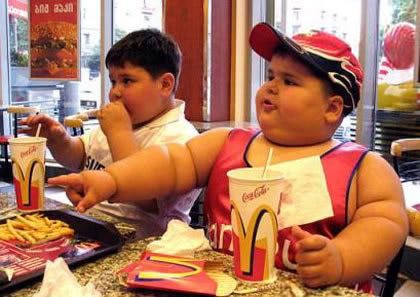
Finally, there was in article about the worst restaurant food for kids. Fact is that 50% of all American kids are either overweight or obese (and 15% are at risk for becoming obese). A few figures to keep in mind: A small adult woman needs about 2,000 calories per day; an Au Bon Pain's "kid's"grilled cheese sandwich is 670 calories and Baskin Ronbin's kid-size M&M shake is 980 calories. Thank you to the Bloomberg administration for forcing chains and big operations to post calorie counts clearly in NYC! Just the other day, I was desiring an Icee at a movie theater. A medium was only fifty cents less than a large, but the medium was 475 calories and the large was almost 900 calories, so regardless of the price silliness, I went for the smaller one. I look forward to having the information to teach my child how to eat around a menu smartly and healthfully.

We quickly moved into more student presentations, with U.K. Sara giving an amusing talk on basil, which concluded with references to Basil Faulty and Basil Brush, a rather rude puppet character from an English kid's TV show. Valle Powerpointed an overview of goat meat, Zach had an attractive PPT on sugar (but he simply read all the text on the screen, rather than actually presenting his material in an original way).


We moved on to food costing, but not before Richard brought up a picture I sent him from my cell phone: A posting in the front door of Rice to Riches on Spring Street, which is looking for staff -- despite the rather blunt assessment of how horrible the work is!

We worked on some sample recipe cards, including a butcher test card (which accounts for different cuts of a large piece), and the market value of the different pieces....as well as the useless trim (i.e., what is lost in the cutting and/or discounted). It's pretty straightforward once you get over the measurement conversion (pounds to ounces! liters to cups!).